

Healthcare
Improved patient care, enhanced data security, and streamlined administrative processes. HIPAA-aligned audit trails.
Stop losing documents in folders nobody can find. A Document Management System (DMS) stores, indexes, versions, and automates the flow of every electronic document and scan, so retrieval takes seconds, audits take minutes, and compliance is a setting, not a fire drill.
4.9·1,411 Google reviews·No lock-in
Free 30-min call with a DMS specialist. We map your compliance needs and team size to the right deployment, then send a real quote, not a brochure.

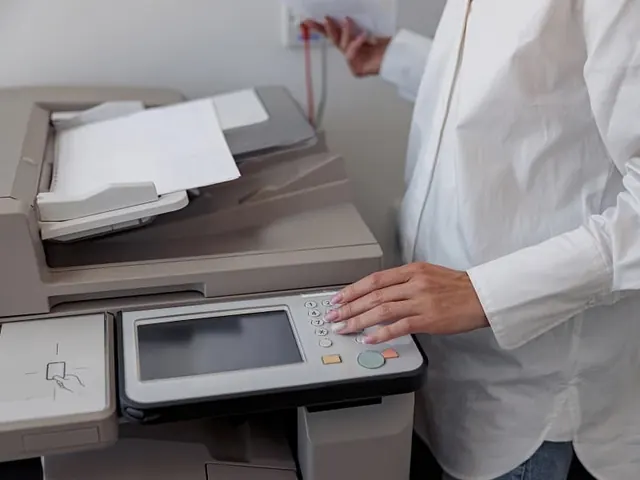
A Document Management System (DMS) is a software solution designed to store, manage, and track electronic documents and images of paper-based information captured through document scanning. It is a central hub for documents, a traffic controller for workflows, and a compliance record all in one.



The right deployment depends on how much control you need over the data, how distributed your team is, and what compliance rules apply. Most mid-market customers land on hybrid or cloud.
Tick what applies to see a likely fit. We confirm it with you on the free call.
Installed and run on the local servers within your IT infrastructure. Complete control over data and security, ideal for organizations with strict compliance requirements (healthcare, government, defense). Requires significant IT resources and upfront investment.
Combines elements of on-premise and cloud. Store sensitive or critical documents on local servers while leveraging cloud for less critical data. Balance of control, flexibility, and cost-effectiveness.
Hosted on remote servers and accessed via the internet. Greater flexibility, scalability, and cost savings. Eliminates the need for extensive on-premise infrastructure. Best for distributed teams and fast scaling.
These are the wins that matter: retrieval in seconds instead of minutes, clean audit trails that pass inspection, and automated workflows that stop hiding in someone's inbox.
Advanced search with indexing and metadata tagging. Documents are found quickly and easily, improving productivity and reducing time spent searching for information.
Track and manage multiple versions of a document. The most recent version is always available, reducing errors and confusion across teams.
Comprehensive audit trails track document access and modifications. Essential for compliance with industry regulations and standards, and shows a clear record of document handling.
Automates the routing and approval of documents. Reduces the time and effort required to manage documents and improves overall business efficiency.
Robust security features including encryption, role-based access controls, and secure document sharing to protect sensitive information end-to-end.
Digitize paper records with document scanning, reclaim the filing room, and eliminate physical storage costs.
When you're comparing DMS software, these are the capabilities that separate a real document management platform from glorified shared drives.
Quickly access documents based on keywords, dates, and metadata. Organized documents with multiple taxonomies and no more manual tagging.
Store documents electronically and retrieve them in seconds. Eliminates physical storage costs and reduces risk of lost or damaged documents.
Track different versions, access previous versions, and compare changes. Everyone is always working on the most current version of the document.
Multiple users work on the same document simultaneously. Improves teamwork and keeps everyone on the same page with the latest information.
Organize, store, and maintain records so they're easily accessible and comply with retention rules. Automated archiving for long-term retention.
Encryption, access controls, and secure document sharing. Protects confidential information and complies with data protection regulations.
No rip-and-replace.
Most DMS rollouts fail because nobody planned the migration. The steps below are the ones that matter. Skip them and you're buying a second filing room, not a system.
Define goals, select a project team, and develop an implementation plan with real deadlines and real owners.
Customize the DMS to your business: set up document indexing, workflows, roles, and security settings.
Transfer existing documents and metadata into the new system. Accurately captured and organized, with data integrity checked.
Train employees on daily usage and conduct thorough testing to identify and resolve issues before go-live.
Launch the DMS and provide ongoing support to ensure a smooth transition and to address any challenges that arise.
We've implemented DMS across healthcare, finance, manufacturing, and education. The configurations are very different, but the headline outcome is the same: faster retrieval, cleaner audits, fewer leaks.
Improved patient care, enhanced data security, and streamlined administrative processes. HIPAA-aligned audit trails.
Increased compliance, better document tracking, and reduced risk of data breaches. SOX-ready audit trails.
Enhanced collaboration on design docs, improved process efficiency, and reduced downtime via better document management.
Streamlined document workflows, improved access to information, and enhanced collaboration among faculty and students.
Matter-centric organization, version-safe drafting, and retention policies that map directly to bar requirements.
Records retention, FOIA-ready search, and secure access controls for sensitive or classified materials.
Still unsure? Call (888) 574-5120 or book the free consultation below.
A shared drive is storage. A DMS is storage plus indexing, version control, audit trails, workflow automation, permission management, retention rules, and compliance reporting. If you've ever lost a contract in a folder called "Final_v3_USE_THIS," you need a DMS, not more drive space.
We scope a realistic timeline during the free consultation.
Cloud-based DMS typically runs $15–$60 per user per month depending on features, storage, and compliance requirements. On-premise solutions have a larger upfront investment and lower ongoing cost. We match the deployment model to your business, not a vendor's sales goals.
Yes. Modern DMS platforms integrate with Microsoft 365, Google Workspace, Salesforce, QuickBooks, NetSuite, Epic, and most major CRM/ERP/EHR systems. We verify integrations against your current stack before you sign anything.
We handle document scanning and data capture as part of implementation. Paper records are digitized, OCR'd, indexed, and migrated into the DMS with metadata intact. Your retention clock stays accurate and your audit trail starts clean.
Yes, when configured correctly. We implement encryption at rest and in transit, role-based access, audit logging, retention rules, and geographic data residency. Compliance requirements drive the configuration choices, not the other way around.
Cloud and hybrid DMS models are designed for distributed teams. Remote employees get secure, role-based access from any device, with full audit logging. On-premise can support remote access via VPN or secure gateway.
We export your documents and metadata in standard formats (PDF/A, XML, CSV for metadata) so you're never locked in. Ownership of your data stays with you, always.
Free DMS consultation. We'll map your compliance needs, document volume, and team size to the right deployment, and give you a real quote.